


- Introduction: The Hidden Foundation of Digital Excellence
- Understanding Data Architecture: Beyond Technical Blueprints
- The Enterprise Architecture Context: Data as a Strategic Domain
- Enterprise Data Architecture: Building Comprehensive Information Systems
- Implementation Strategy: From Architecture to Action
- Governance and Quality Assurance
- Overcoming Implementation Challenges
- Future Directions: Architecture in the Age of AI and IoT
- Conclusion: Building the Foundation for Tomorrow's Success
- Take Action: Begin Your Architectural Journey
Introduction: The Hidden Foundation of Digital Excellence
Picture this: A multinational automotive manufacturer announces their revolutionary connected car initiative, promising real-time diagnostics, predictive maintenance, and seamless integration with smart city infrastructure. The marketing launch is spectacular, the technology impressive, and the market response enthusiastic. Six months later, the project stalls. Data from millions of sensors can’t be integrated, customer information exists in seventeen different formats across departments, and the promised AI-driven insights remain locked in incompatible systems.
Organizations across every industry are dealing with these kinds of data integration issues as they navigate the third wave of digital transformation. From traditional manufacturers adding IoT capabilities to their products, to healthcare providers implementing telemedicine platforms, to financial institutions building real-time fraud detection systems, the challenge remains consistent: without proper data architecture, even the most innovative digital initiatives crumble under the weight of their own complexity.
In today’s hyperconnected world, data architecture has evolved from a technical concern to a strategic imperative that determines whether organizations thrive or merely survive in the digital economy. The companies that recognize this reality and invest in comprehensive data architecture practices position themselves not just for current success, but for sustained competitive advantage in an increasingly data-driven future.
Understanding Data Architecture: Beyond Technical Blueprints
The Art and Science of Data Organization
Data Architecture represents the fundamental organization of an enterprise’s data assets, embodied in their components, relationships, and the principles governing their design and evolution. Like the architectural plans that guide the construction of skyscrapers, data architecture provides the master blueprint that ensures all data-related initiatives work together harmoniously rather than creating isolated digital silos.
The discipline encompasses three essential components that work in concert to create organizational value. Data Architecture outcomes include the tangible artifacts such as enterprise data models, data flows, and integration specifications that define how information moves through the organization. Data Architecture activities encompass the strategic planning, design, and implementation processes that bring these blueprints to life. Finally, Data Architecture behavior involves the collaborative mindsets, skills, and cultural practices that enable effective architectural thinking throughout the enterprise.
This holistic approach distinguishes modern data architecture from traditional database design. While database administrators focus on optimizing individual systems, data architects think enterprise-wide, ensuring that every data decision supports broader business objectives and enables future innovation.
The Strategic Bridge Between Vision and Execution
Data Architecture serves as the critical bridge between business strategy and technology execution. When Volvo decided to transform from a car manufacturer into a mobility services provider, offering on-call concierge services and pay-per-use vehicle access, they required data architecture that could support entirely new business models. Traditional automotive data systems designed for manufacturing and sales couldn’t accommodate real-time customer interactions, predictive maintenance algorithms, or dynamic pricing models.
This transformation exemplifies how data architecture enables organizations to quickly evolve their products, services, and capabilities to capitalize on emerging opportunities. Without proper architectural foundations, innovative business models remain mere concepts rather than executable strategies.
The Enterprise Architecture Context: Data as a Strategic Domain
Understanding Architectural Domains
Data Architecture operates within the broader context of enterprise architecture, alongside business, application, and technology architecture domains. Each domain serves distinct but interconnected purposes that collectively enable organizational effectiveness.
Business Architecture identifies how enterprises create value for customers and stakeholders through business models, processes, capabilities, and services. This domain establishes the requirements that drive all other architectural decisions and provides the strategic context for data initiatives.
Enterprise Data Architecture describes how data should be organized and managed to support business requirements. This includes data models, definitions, mapping specifications, and flow designs that ensure information assets enable rather than constrain business capabilities.
Application Architecture defines the structure and functionality of software systems that process and manipulate data according to business requirements. These applications act on data specified by the data architecture to deliver business value.
Technology Architecture describes the physical platforms, networks, security infrastructure, and integration tools that host and execute application capabilities while ensuring reliable data processing and storage.
The interdependencies between these domains require collaborative architectural practices. Data architects must understand business requirements deeply enough to design information systems that enable strategic objectives, while also working closely with application and technology architects to ensure that data designs can be implemented effectively within existing technical constraints.
Leveraging Architectural Frameworks
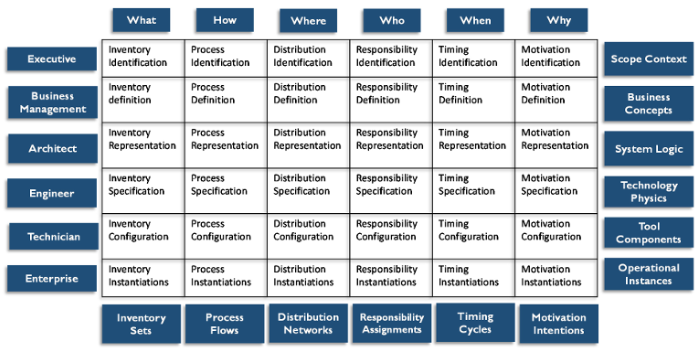
The Zachman Framework provides one of the most comprehensive approaches to understanding these architectural relationships. Developed in the 1980s and continuously evolved, the framework creates a 6×6 matrix that addresses fundamental questions (what, how, where, who, when, why) from different stakeholder perspectives (planner, owner, designer, builder, implementer, user).
For data architects, this framework proves particularly valuable because it clarifies how data requirements vary across organizational levels and stakeholder groups. Executive leaders need high-level data strategies that align with business objectives, while technical implementers require detailed specifications for database schemas and integration processes. The framework ensures that data architecture artifacts address the needs of all relevant stakeholders while maintaining consistency across perspectives.
Enterprise Data Architecture: Building Comprehensive Information Systems
The Enterprise Data Model Foundation

The Enterprise Data Model represents the cornerstone of comprehensive data architecture. This holistic, enterprise-level conceptual and logical data model provides a common, consistent view of data across the entire organization. Unlike project-specific models that address narrow requirements, the EDM establishes the foundation for all data-related initiatives and ensures consistency across diverse business capabilities.
Successful EDMs are typically built using layered approaches that accommodate different levels of detail and abstraction. At the highest level, conceptual models identify major subject areas and their relationships. Subject area models provide more detailed views of entities and relationships within specific business domains. Logical models add attributes and business rules to these entities, while physical models specify implementation details for particular applications or projects.
This layered structure enables organizations to manage complexity while maintaining enterprise coherence. A mobile device entity might appear in the enterprise conceptual model as part of the Product subject area, be detailed in the Product logical model with specific attributes and relationships, and be implemented in multiple physical models optimized for different applications such as inventory management, customer service, and warranty tracking.
The key to EDM success lies in establishing clear linkages between layers. Vertical linkages trace entities from conceptual models down to physical implementations, creating audit trails that help organizations understand how business concepts are represented in operational systems. Horizontal linkages connect related entities across subject areas, ensuring that relationships between business domains are properly maintained.
Data Flow Design: Mapping Information Movement
While enterprise data models define what data exists, data flow designs specify how information moves through business processes and systems. These specifications prove crucial for understanding data lineage, identifying integration requirements, and ensuring that business processes have access to the information they need when they need it.
Data flows can be documented at multiple levels of detail, from high-level subject area flows that show how major information categories move between business capabilities, to detailed attribute-level specifications that define exactly how individual data elements are transformed as they move between systems.
Matrix representations provide comprehensive overviews of data relationships between processes or business capabilities. These matrices clarify which processes create data, which processes consume information, and what dependencies exist between different business activities. Such documentation proves invaluable for understanding the impact of system changes, planning integration projects, and identifying opportunities for process optimization.
Data flow diagrams complement matrix representations by providing visual depictions of how information moves through systems and processes. These diagrams help stakeholders understand complex integration scenarios and identify potential bottlenecks or failure points in critical business processes.
Implementation Strategy: From Architecture to Action
Establishing Architectural Practice
Successful data architecture implementation requires establishing formal practices that integrate architectural thinking into all data-related activities. This involves selecting appropriate frameworks that align with organizational culture and business requirements, developing roadmaps that prioritize architectural initiatives based on business value, and embedding architectural activities into project delivery methodologies.
The choice of architectural framework significantly impacts implementation success. Government organizations often benefit from frameworks specifically designed for public sector requirements, while commercial enterprises might prefer frameworks that emphasize business agility and innovation. The key is selecting frameworks whose views and taxonomy facilitate effective communication with diverse stakeholders, particularly business leaders who must champion architectural initiatives.
Organizations must also decide whether to implement data architecture as part of broader enterprise architecture practices or establish standalone data architecture capabilities. While integration with enterprise architecture provides valuable alignment and coordination benefits, some organizations find that establishing focused data architecture teams enables more rapid progress on critical data management challenges.
Project Integration and Requirements Management
Data architecture creates the most value when architectural thinking is embedded throughout project lifecycles rather than being treated as an optional add-on. This requires developing processes that ensure architectural considerations are addressed from project initiation through implementation and ongoing operations.
During project scoping, architects must evaluate how individual initiatives contribute to overall enterprise data architecture while identifying opportunities for reuse and standardization. Projects should be designed to leverage existing architectural assets wherever possible while contributing new capabilities that benefit the broader organization.
Requirements analysis must capture not only immediate project needs but also long-term architectural implications. Data architects need to understand how project-specific requirements relate to enterprise patterns and identify opportunities for generalization that enable future reuse.
Design activities should validate that project specifications conform to architectural standards while identifying areas where standards might need to be updated or enhanced. The goal is ensuring that projects deliver immediate business value while contributing to long-term architectural coherence.
Implementation approaches vary depending on development methodology. Waterfall methodologies naturally accommodate architectural activities through sequential phases and formal tollgates. Agile methodologies require more creative approaches to ensure that architectural considerations are addressed within sprint-based delivery cycles. The key is ensuring that architectural thinking informs design decisions regardless of the specific methodology employed.
Roadmap Development and Dependency Management
Effective data architecture implementation requires comprehensive roadmaps that address both business requirements and technical dependencies. These roadmaps must balance ideal future state visions with practical constraints imposed by existing systems, organizational capabilities, and resource availability.
Business-data-driven roadmaps start with capabilities that have the least dependency on other activities and progress through increasingly complex capabilities that depend on multiple data sources. For example, product management and customer management capabilities typically serve as master data foundations that support more complex capabilities such as sales order management and customer invoice processing.
This dependency-based approach ensures that architectural initiatives build upon solid foundations rather than creating unstable structures that require extensive rework as additional capabilities are implemented. The roadmap becomes a strategic guide that helps organizations sequence investments to maximize business value while minimizing technical risk.
Governance and Quality Assurance
Architectural Oversight and Standards
Data architecture governance ensures that architectural investments deliver expected business value while maintaining long-term system coherence. This involves establishing oversight processes that monitor project compliance with architectural standards, managing the lifecycle of architectural assets, and defining standards that guide consistent data usage throughout the organization.
Project oversight activities include ensuring that development initiatives comply with required data architecture activities, use and improve existing architectural assets, and implement solutions according to established standards. This oversight prevents the gradual degradation of architectural coherence that occurs when projects optimize for short-term delivery at the expense of long-term maintainability.
Architectural asset management involves defining, evaluating, and maintaining the designs, models, and specifications that constitute the organization’s data architecture. These assets serve as organizational knowledge repositories that enable consistent decision-making and facilitate knowledge transfer as personnel change.
Standards definition establishes the rules, guidelines, and specifications that govern how data is used within the organization. These standards should be specific enough to ensure consistency while remaining flexible enough to accommodate legitimate business requirements and emerging technologies.
Performance Measurement and Continuous Improvement
Measuring data architecture effectiveness requires balanced metrics that address compliance, implementation efficiency, and business value creation. Architecture standard compliance rates measure how closely projects adhere to established patterns and processes, providing insight into the practical utility of architectural guidance.
Implementation trend metrics track whether architectural investments improve organizational capabilities over time. Use, reuse, replace, and retire measurements help organizations understand whether architectural assets are actually being leveraged or whether projects continue to create redundant capabilities that increase maintenance complexity.
Business value measurements focus on the ultimate purpose of architectural investments: enabling improved business performance. These metrics might include business agility improvements that result from reduced project delivery times, business quality improvements that stem from better data consistency and integration, and operational efficiency gains that result from standardized processes and reduced error correction activities.
Overcoming Implementation Challenges
Managing Organizational Change
Data architecture implementation often requires significant cultural and organizational changes that can create resistance if not managed carefully. Traditional development cultures that emphasize rapid delivery and local optimization may view architectural requirements as bureaucratic obstacles rather than strategic enablers.
Successful change management requires demonstrating that architectural practices enable rather than constrain innovation. Organizations must show that upfront architectural investment reduces long-term development costs, improves system reliability, and enables capabilities that would be impossible with ad hoc approaches.
Cultural change also requires developing architectural awareness throughout the organization. Business stakeholders need to understand how architectural decisions impact business capabilities, while technical teams need to develop skills in architectural thinking and collaborative design practices.
Risk Mitigation and Success Factors
Data architecture initiatives face several common risks that can derail implementation efforts. Lack of sustained management support represents the most significant risk, as architectural benefits often emerge over time rather than delivering immediate visible results. Organizations must establish architectural sponsorship among multiple senior leaders to ensure continuity through organizational changes.
Counter-productive executive decisions can undermine architectural efforts when business leaders make technology choices without considering architectural implications. This risk can be mitigated through regular communication about architectural objectives and involving architects in strategic technology decisions.
Culture shock occurs when architectural formality conflicts with existing informal development practices. Organizations can address this risk by implementing architectural practices gradually, demonstrating early wins, and providing training that helps teams understand the benefits of architectural approaches.
Future Directions: Architecture in the Age of AI and IoT
Emerging Technology Integration
The proliferation of Internet of Things devices, artificial intelligence applications, and edge computing capabilities is creating new architectural challenges that require evolved approaches to data architecture. Traditional architectures designed for centralized data processing must be enhanced to support distributed intelligence, real-time decision-making, and massive scale data ingestion.
Modern data architectures must accommodate both human-generated business data and machine-generated sensor data, often with dramatically different volume, velocity, and variety characteristics. This requires architectural patterns that can handle structured business transactions alongside unstructured IoT telemetry while maintaining data quality and governance standards across diverse data types.
Regulatory and Privacy Considerations
Evolving privacy regulations, data localization requirements, and algorithmic transparency mandates are creating new architectural requirements that must be embedded into fundamental system designs rather than being addressed as compliance overlays.
Data architects must design systems that enable compliance with regulations that may not have existed when the systems were originally conceived. This requires architectural flexibility and governance capabilities that can adapt to changing regulatory requirements without requiring complete system redesigns.
Conclusion: Building the Foundation for Tomorrow’s Success
Data architecture represents far more than technical documentation or system blueprints. It embodies the strategic foundation that enables organizations to transform data from operational byproduct into competitive advantage. In an era where digital capabilities determine market leadership, the organizations that invest in comprehensive data architecture position themselves to capitalize on emerging opportunities while their competitors struggle with legacy system limitations.
The transformation from traditional IT-centric data management to strategic data architecture requires sustained commitment, cultural change, and architectural thinking that spans business and technology domains. However, the organizations that make this investment successfully create sustainable competitive advantages that compound over time.
The examples throughout this article, from Volvo’s transformation into a mobility services provider to the challenges facing connected car initiatives, demonstrate that data architecture success isn’t measured by the elegance of technical designs but by the business capabilities those designs enable. The most sophisticated data models have no value if they don’t support business objectives, while even simple architectural patterns can create enormous value when they align with strategic requirements.
Take Action: Begin Your Architectural Journey
The digital transformation imperative means that every organization must eventually address data architecture challenges. The question isn’t whether to invest in data architecture capabilities, but whether to lead the transformation proactively or react to architectural debt reactively.
Organizations ready to begin their data architecture journey should start with honest assessments of current state capabilities and readiness for architectural change. This includes evaluating existing documentation, understanding current data flows, and identifying the business drivers that will motivate sustained architectural investment.
Success requires establishing architectural practices that integrate with existing development methodologies while creating value for both business and technical stakeholders. Start with pilot initiatives that can demonstrate architectural value quickly, then expand successful patterns throughout the organization.
Remember that data architecture is ultimately about enabling business success through better data management. Every model created, every standard established, and every process improved should contribute to improved business performance and enhanced competitive positioning.
The data architecture revolution is already underway. Organizations that embrace architectural thinking and invest in comprehensive data architecture capabilities will shape the future of their industries. Those that postpone these investments will find themselves struggling to catch up with competitors who recognized the strategic importance of data architecture and acted decisively.
Your data is waiting. Your organization needs architectural foundation. The only question is: will you lead the transformation or follow others who had the vision to build their data architecture foundation when the opportunity was clear?